
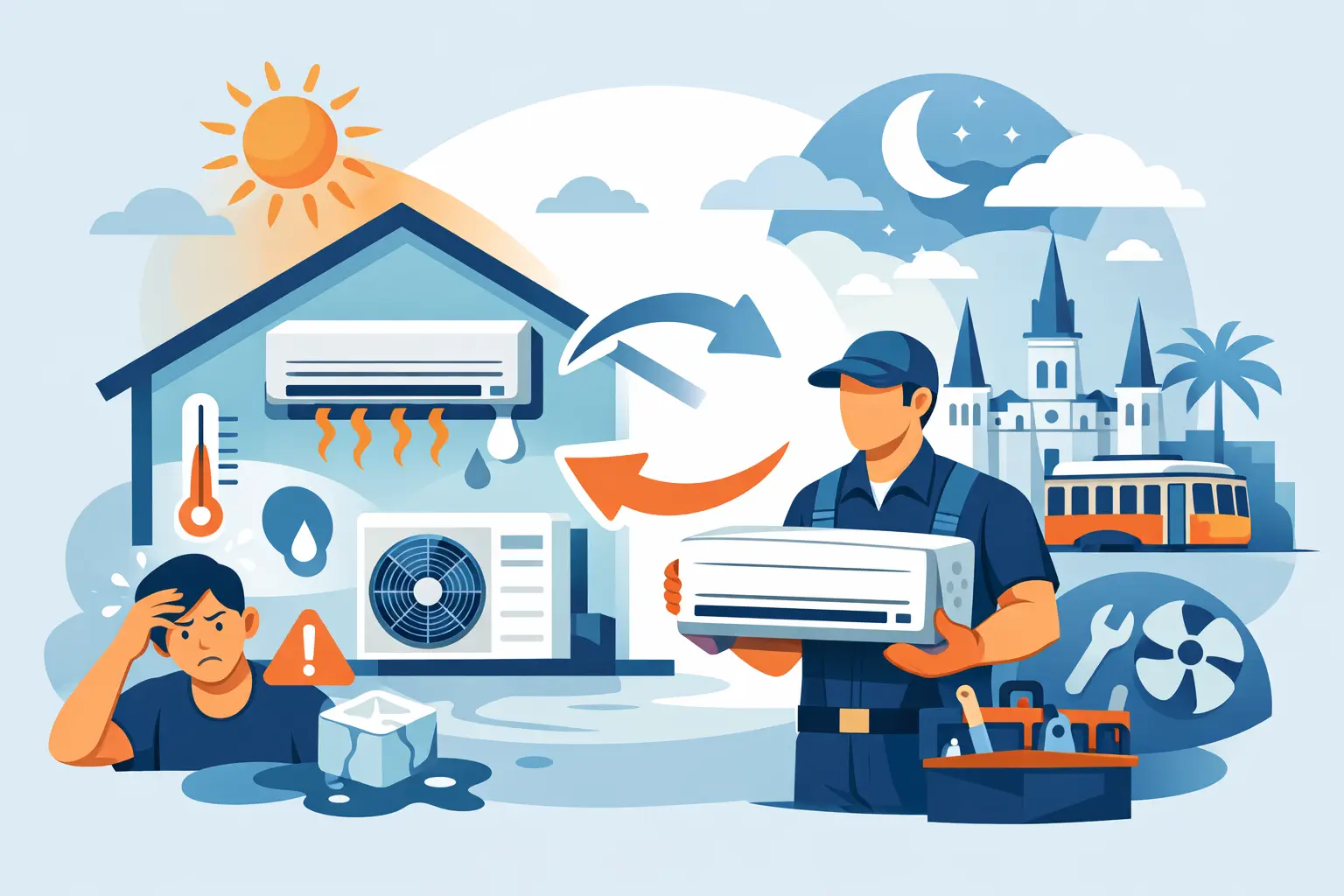
A New Orleans AC system can seem to be running while your home still feels sticky, unevenly cooled, and expensive to live in. The most useful signs you need AC replacement are not always a complete breakdown. They are often a pattern of higher utility bills, repeat repairs, weak comfort, and equipment that cannot keep up with Gulf Coast heat and humidity.
Replacing an air conditioner is a significant property decision, so it should not be based on age alone or one bad service call. A licensed HVAC technician can determine whether a targeted repair will restore dependable performance or whether continued repairs are putting more money into a system near the end of its service life.
Signs You Need AC Replacement Instead of Another Repair
Your system is 10 to 15 years old and problems are increasing
Age does not automatically mean an AC unit must be replaced. Well-maintained equipment can sometimes provide reliable service beyond a decade. But once a system reaches roughly 10 to 15 years old, parts wear, efficiency declines, and repair needs often become more frequent.
Older equipment may also use an outdated refrigerant or have components that are harder and more costly to source. If an older system needs a major repair, such as a compressor, condenser coil, or evaporator coil, compare the repair cost with the value and expected remaining life of a replacement system. A smaller repair may still be worthwhile. A major repair on aging equipment often deserves a closer look.
Repair calls are becoming routine
One repair after years of dependable service is normal. Several repairs in a short period are different. Replacing capacitors, contactors, motors, or electrical components may keep the system operating temporarily, but a repeated pattern can indicate broader wear throughout the equipment.
Consider the total cost, not just the latest invoice. Add up recent repair expenses, the likelihood of another failure during peak summer demand, and the cost of lost comfort if the system quits when service schedules are busiest. For rental properties and commercial spaces, downtime can also affect tenants, employees, customers, and temperature-sensitive inventory.
Your utility bills rise without a clear reason
New Orleans summers place a heavy load on air conditioning, so bills naturally rise when temperatures and humidity climb. What deserves attention is a substantial increase compared with similar weather periods, especially when your cooling habits have not changed.
An AC system may consume more electricity because the compressor is losing efficiency, coils are dirty or damaged, refrigerant levels are incorrect, or air flow is restricted. Sometimes the issue is not the unit itself. Leaky ductwork, inadequate attic insulation, air infiltration, and moisture problems can make an otherwise functional system run far longer than it should.
That is why replacement decisions should account for the whole building. A correctly sized new AC system can still underperform if cooled air escapes through leaky ducts or hot, humid outside air enters through gaps in the structure.
Your home feels cool but humid
In Southeast Louisiana, temperature alone is not the full measure of comfort. An AC system should remove moisture as it cools. If rooms feel clammy, bedding feels damp, or indoor air has a persistent musty quality, your system may not be controlling humidity effectively.
High indoor humidity can result from improper system sizing, short cycling, reduced cooling capacity, duct leakage, drainage issues, or building-envelope gaps. It can also contribute to condensation and create conditions that support mold growth. A replacement may be appropriate, but the right answer depends on the cause. Installing a larger unit without addressing air leakage or moisture sources can make humidity control worse.
The system runs constantly or short cycles
An AC that runs most of the day during an extreme heat advisory may be working under normal seasonal stress. But if it rarely shuts off during ordinary hot weather, cannot reach the thermostat setting, or runs for long periods with little improvement, it needs evaluation.
The opposite pattern can be just as concerning. Short cycling occurs when the unit turns on and off repeatedly before completing a normal cooling cycle. This can increase wear, raise energy use, and leave humidity behind. Causes range from thermostat issues and dirty filters to refrigerant problems, incorrect sizing, and failing equipment.
A technician should diagnose the reason before recommending replacement. If the system is undersized for an addition, oversized for the space, or paired with poor duct design, a like-for-like replacement may repeat the same comfort problem.
Some rooms never stay comfortable
A hot upstairs bedroom, a warm back office, or a commercial area that never reaches a usable temperature can point to an aging AC system. It can also indicate a ductwork, insulation, zoning, or air-sealing issue.
Pay attention to where the problem occurs. If one room is uncomfortable while the rest of the building is fine, the issue may be localized. If every area struggles, the system may be losing capacity or failing to distribute air properly. A complete assessment should include air flow, return-air pathways, duct condition, insulation, and the impact of sunlight and building layout.
You hear new or worsening noises
Air conditioners make some ordinary operating sounds, including a low fan hum and the click of a system starting. Grinding, banging, screeching, rattling, or loud buzzing should not be ignored. These sounds can signal loose parts, motor trouble, compressor issues, or electrical concerns.
Some noise problems are repairable. However, if major mechanical noise accompanies poor cooling, high bills, and frequent repairs, replacement can be the more dependable choice. Shut the system down and request service promptly if you smell burning, notice electrical arcing, or hear severe mechanical sounds.
Refrigerant leaks keep returning
Refrigerant does not get used up like fuel. If your system is low, there is typically a leak that needs to be found and repaired. Simply adding refrigerant without addressing the source is not a long-term solution.
A small, accessible leak may be repairable. Repeated leaks, extensive coil damage, or equipment that uses older refrigerant can change the calculation. In those cases, investing in replacement may protect you from continued service costs and uncertain cooling performance.
Your system cannot support your property changes
An AC system sized for a smaller house may struggle after an addition, garage conversion, major renovation, or new occupancy pattern. The same applies when a commercial space adds equipment, changes layout, or has more people inside each day.
Before replacing equipment, the contractor should evaluate the current cooling load rather than relying only on the old unit’s size. Windows, insulation, roof condition, ductwork, air leakage, and shade all affect the result. Proper sizing helps prevent short cycling, humidity problems, excessive energy use, and premature wear.
What to Check Before Replacing Your AC
Start with the basics. A clogged filter, blocked return grille, tripped breaker, thermostat setting, or dirty outdoor condenser can create symptoms that resemble a failing system. Regular maintenance is still the best way to protect an AC unit that has useful life remaining.
If the issue persists, request a professional evaluation that looks beyond the outdoor unit. Useful diagnostics include checking refrigerant performance, electrical components, drain operation, temperature split, air flow, duct leakage, and indoor humidity. For an older system, ask for a clear comparison between the repair cost, expected reliability, efficiency improvement, and replacement options.
For New Orleans-area properties, also consider resilience. High heat, severe weather, and power interruptions can put HVAC equipment under added strain. A planned replacement gives owners time to improve insulation, correct drainage or moisture concerns, and consider backup power needs instead of making rushed decisions after a failure.
Choosing the Right Replacement System
The best replacement is not necessarily the largest unit or the highest-efficiency model on paper. The right system must match the building’s cooling load, ductwork, electrical capacity, and humidity-control needs. Features that improve comfort may have a higher upfront cost, but they can be worthwhile for a home with persistent humidity or rooms with uneven temperatures.
Installation quality matters as much as equipment selection. Correct refrigerant charging, secure duct connections, proper condensate drainage, and accurate thermostat setup all affect performance. Air Tight Construction approaches AC replacement as part of overall building performance, so comfort, moisture control, energy loss, and the condition of connected systems can be considered together.
Do not wait for a midsummer breakdown to start asking questions. If your air conditioner is showing several of these warning signs, a professional assessment now can give you time to choose a practical solution that keeps your property cooler, drier, and more dependable when Louisiana heat settles in.