

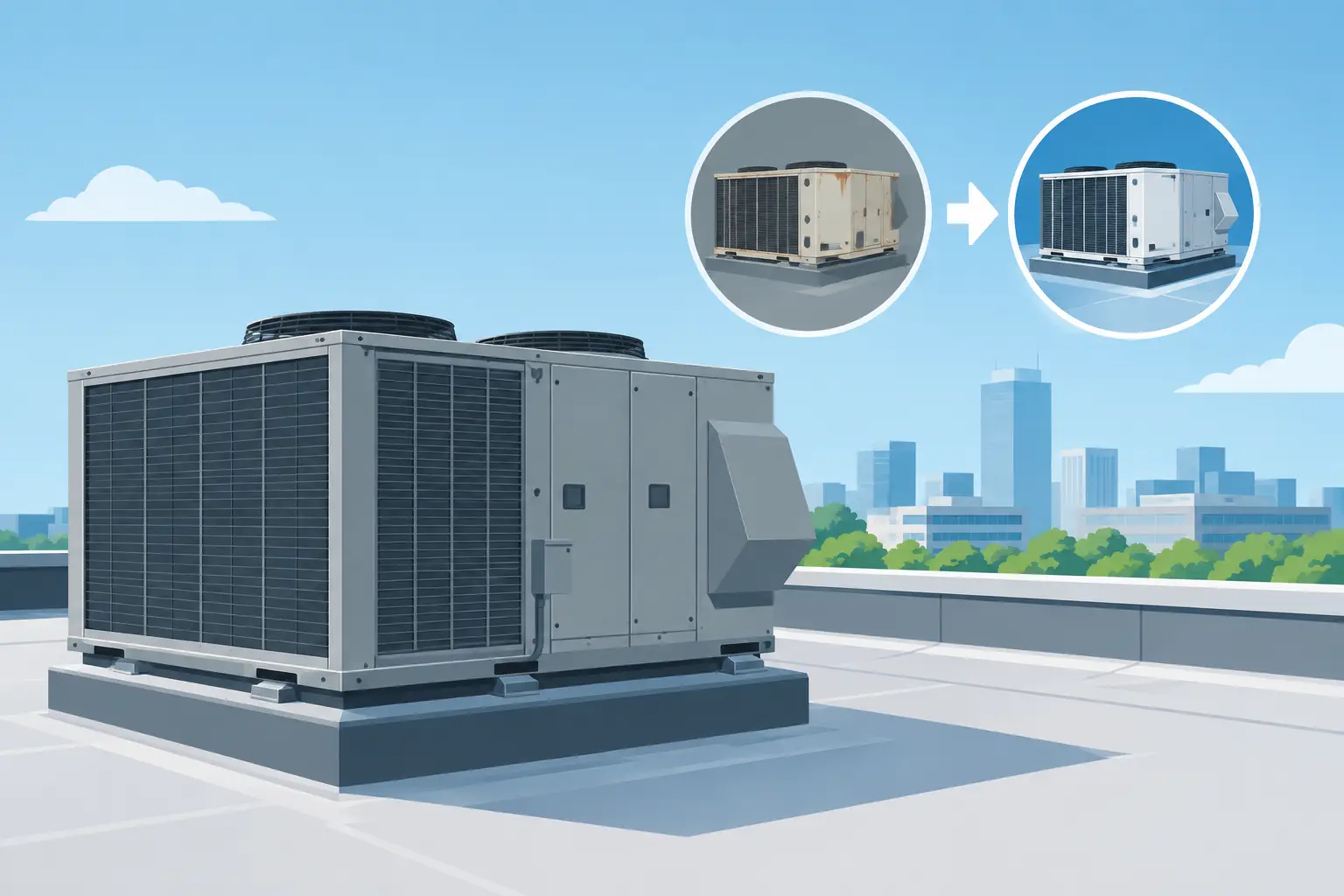
A rooftop unit can keep running long after it stops serving the building well. For New Orleans-area businesses, knowing when to replace a commercial rooftop unit is not just an equipment question. It affects tenant comfort, employee productivity, humidity control, operating costs, inventory protection, and the ability to keep doors open during the hottest part of the year.
A repair can be the right decision when it restores dependable performance at a sensible cost. But repeated service calls, uneven cooling, water problems, and climbing utility bills can signal that the unit is costing more to keep than it is worth. The right answer depends on the unit’s condition, the building’s needs, and what is happening elsewhere in the property.
Start With Age, but Do Not Stop There
Many commercial rooftop units have a practical service life of about 15 to 20 years when they receive regular maintenance. In Southeast Louisiana, that range can be shorter. Long cooling seasons, high outdoor humidity, salt exposure near the coast, storm debris, standing water, and heavy runtime all place added stress on compressors, coils, electrical components, and cabinet materials.
Age alone does not require replacement. A well-maintained 12-year-old unit may still have useful life, while a poorly maintained unit can become unreliable much earlier. The more useful question is whether the equipment is still delivering stable cooling and dehumidification without frequent, expensive intervention.
If a unit is approaching the end of its expected life and has begun needing major components, replacement planning is usually wiser than waiting for a complete failure. That gives a business time to evaluate sizing, budget the project, coordinate installation around operations, and avoid making a rushed decision during an emergency.
When to Replace a Commercial Rooftop Unit Instead of Repairing It
The repair-versus-replace decision should be based on the total cost and risk of keeping the existing equipment in service. A low-cost repair that resolves an isolated issue is often worthwhile. A large repair on an aging unit with a history of failures may only postpone the next disruption.
Replacement deserves serious consideration when a unit has recurring compressor failures, refrigerant leaks, damaged coils, major electrical problems, or a failing heat exchanger. These issues can be costly on their own, and they may indicate broader wear throughout the system.
A helpful rule is to compare the repair cost with the unit’s age, remaining expected life, and recent repair history. If one repair represents a significant portion of replacement cost, especially on equipment that is already near the end of its useful life, investing in new equipment often provides better value. This is not a fixed formula. A unit serving a critical space, such as a restaurant, medical office, server room, or retail area with sensitive inventory, may justify replacement sooner because downtime carries its own cost.
Frequent breakdowns also affect more than the HVAC budget. Emergency service, unhappy tenants or customers, temporary cooling arrangements, lost work time, and moisture-related cleanup can quickly make an older unit more expensive than it appears on paper.
Watch for Comfort and Humidity Problems
In the Gulf South, cooling and moisture control must work together. A rooftop unit that lowers the temperature but leaves a building damp is not performing the full job. Excess indoor humidity can make occupants feel uncomfortable even at a reasonable thermostat setting. It can also contribute to condensation, odors, mold-friendly conditions, and damage to finishes or stored materials.
Warning signs include rooms that stay warm in the afternoon, thermostat complaints from certain areas, clammy indoor air, condensation on vents or windows, musty odors, and water around ceiling diffusers. These symptoms do not automatically mean the rooftop unit needs replacement. They can also point to duct leakage, poor insulation, oversized equipment, air infiltration, drainage issues, or controls that need adjustment.
That is why an equipment decision should include a building-performance review. If the roof, ductwork, insulation, and building envelope are allowing heat and humid air into the structure, even a new rooftop unit may work harder than necessary. Addressing those connected conditions can improve comfort, reduce runtime, and help protect the investment in new HVAC equipment.
Rising Energy Use Is a Meaningful Signal
Commercial utility bills naturally change with weather, occupancy, operating hours, and equipment loads. Still, a steady increase in cooling costs without a clear operational reason deserves attention. Older rooftop units can lose efficiency as coils become restricted, motors wear, refrigerant charge issues develop, controls drift, and compressors lose capacity.
A new unit may offer improved efficiency, but the savings should be evaluated realistically. Replacement makes the most sense when efficiency gains are combined with fewer repairs, better humidity control, more reliable operation, and proper equipment sizing.
An oversized unit can cycle too quickly and struggle to remove moisture. An undersized unit may run continuously during peak heat and still fail to maintain conditions. Before selecting a replacement, a qualified contractor should consider the building’s square footage, layout, occupancy, internal heat loads, operating schedule, duct condition, insulation levels, and recent renovations. A restaurant kitchen, retail space, warehouse office, and multi-tenant building do not have the same cooling profile.
Refrigerant Availability Can Change the Decision
Older rooftop equipment may use refrigerants that are being phased down or becoming more expensive to obtain. If an aging unit develops a significant refrigerant leak, the cost of leak repair and recharge can be substantial. More importantly, a leak that is repaired today may not be the last one in an older coil or line set.
This does not mean every unit using an older refrigerant must be replaced immediately. If the system is otherwise reliable and the repair is limited, continued operation may be reasonable. But refrigerant-related repairs should prompt an honest discussion about future costs and the availability of parts and service support. Planning replacement before a major leak or compressor failure gives owners more control over timing and equipment selection.
Storm Exposure and Roof Conditions Matter
Commercial rooftop units in Southeast Louisiana face conditions that indoor equipment never sees. High winds can damage panels, electrical disconnects, supports, and duct connections. Wind-driven rain can enter compromised cabinet seams or roof curbs. Debris can block condenser coils, while roof drainage problems can leave equipment or surrounding areas exposed to standing water.
After a major storm, an HVAC inspection should look beyond obvious exterior damage. Technicians should check mounting stability, electrical connections, coil condition, refrigerant lines, condensate drainage, curb integrity, and controls. A rooftop unit may start after a storm yet develop reliability problems later if moisture entered electrical components or structural damage was overlooked.
Replacement may also be the right time to coordinate roof repairs, curb modifications, electrical upgrades, and backup-power planning. Coordinating these pieces can reduce repeat mobilization and help avoid installing new HVAC equipment on a roof section that will soon need major work.
Plan the Replacement Around the Building
A commercial rooftop replacement should be managed as a property project, not simply a box swap. The process may involve permits, crane access, roof protection, electrical work, thermostat or control upgrades, duct transitions, drainage corrections, and a clear schedule for minimizing disruption.
Facility managers should also consider whether the business can operate during the changeout. Some locations can schedule work after hours or on a closed day. Others need temporary cooling, phased installation, or advance communication with tenants. For critical operations, backup power capacity and startup loads should be reviewed as part of the project.
Air Tight Construction approaches commercial HVAC decisions with the wider property in mind. That means looking at the equipment, but also the moisture conditions, insulation, airflow, roof interface, and power needs that affect how the system performs after installation.
A planned replacement is usually less stressful and less expensive than an emergency response during a July heat wave. If your rooftop unit is aging, struggling with humidity, or requiring repeated repairs, schedule an evaluation while there is still time to choose the right solution for the building.