

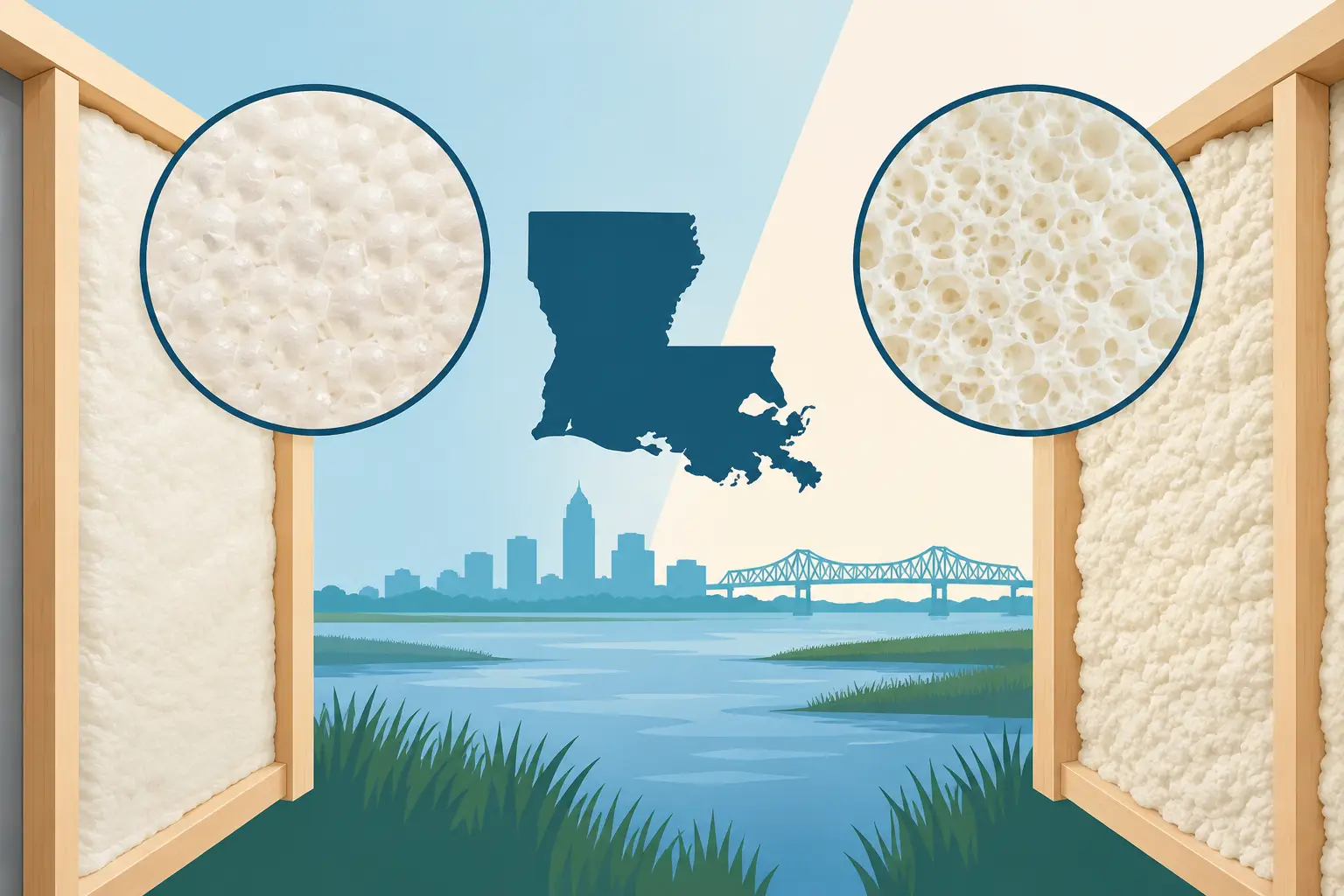
A New Orleans attic can reach punishing temperatures long before the afternoon peak, while humid outdoor air works its way through every unsealed gap in the building envelope. That is why the decision between closed cell versus open cell spray foam is not simply about buying the highest R-value. It affects how a home or commercial building handles heat, humidity, air leakage, roof-deck conditions, and HVAC workload.
Both types of spray foam can improve comfort and reduce energy loss when they are correctly designed and installed. The right choice depends on where the foam will go, how much space is available, whether the assembly needs to dry, and how the rest of the property manages moisture. In Southeast Louisiana, those details matter.
Closed Cell Versus Open Cell: The Basic Difference
Spray foam insulation starts as a liquid material that expands after application. Open-cell and closed-cell foam both fill cracks and irregular spaces better than many traditional insulation materials, but they behave differently once cured.
Open-cell foam is lighter, softer, and expands substantially during installation. Its cells remain partially open, which allows water vapor to move through the material more readily. It typically provides an R-value of about R-3.5 to R-4 per inch. Because it expands so much, open-cell foam can fill wall cavities and roof framing efficiently.
Closed-cell foam is denser and more rigid. Its cells are closed and filled with insulating gas, giving it a higher R-value per inch, often around R-6 to R-7. It also resists water absorption and, at the required thickness for the specific product, can serve as a vapor retarder. This makes it useful where insulation thickness is limited or where moisture resistance is a central concern.
Both products can create an effective air barrier when installed to the manufacturer-required thickness. That air-sealing capability is often one of the biggest performance gains for Louisiana properties. Air leakage brings in more than heat. It can bring humid air into wall cavities, attics, and crawlspaces, where condensation and mold conditions can follow.
Why Moisture Control Changes the Decision
Moisture is the reason a simple insulation comparison can become a building-science decision. A property may have a roof leak, wet framing, poorly drained crawlspace, oversized air conditioner, or gaps around ducts and penetrations. Spray foam is valuable, but it cannot correct each of those conditions on its own.
Closed-cell foam is often selected for areas that need a strong moisture-resistant layer. It can be a practical choice for rim joists, tight wall cavities, metal buildings, and certain crawlspace or exterior-envelope applications. Its density also adds some rigidity to the surface where it is applied, although insulation should not be treated as a substitute for required structural repairs or engineering.
Open-cell foam is vapor permeable, which means an assembly may retain more drying potential in the right design. That can be useful, but it also means the entire wall or roof assembly needs to be considered. In a hot, humid climate, vapor movement, outdoor humidity, interior cooling, and the location of other materials all affect whether moisture can accumulate where it does not belong.
Neither foam should be used to cover active water damage, wet wood, mold growth, or a leaking roof without addressing the source first. A dry, sound substrate is essential. If a roof leak has already affected insulation or framing, remediation and repairs should come before the insulation work.
Where Each Type Often Makes Sense
At the underside of a roof deck, open-cell foam is a common option for creating a conditioned attic. It can fill deep rafter cavities at a lower material cost than closed-cell foam. Bringing ductwork and HVAC equipment inside the conditioned envelope can help reduce the heat gain those systems experience in a traditional vented attic.
However, a conditioned attic changes how the home ventilates, how combustion equipment is evaluated, and how the HVAC system is sized and controlled. The roof must be in good condition before foam is applied. Building code requirements, required ignition barriers, and access for future inspections should all be part of the plan.
Closed-cell foam can be a better fit at a roof deck when maximum R-value is needed in a shallow cavity or when the assembly calls for greater moisture resistance. It may also be appropriate in commercial applications with metal roof systems or limited available depth. The higher price is justified in some locations, but not automatically across an entire building.
For exterior walls, the choice often comes down to cavity depth and moisture design. Closed-cell foam delivers more R-value in a 2×4 wall where space is restricted. Open-cell foam can work well in deeper framing cavities when the wall assembly has been designed to manage vapor and water properly.
For floors over unconditioned areas, rim joists, and certain crawlspace conditions, closed-cell foam is frequently the stronger candidate because of its density and resistance to moisture. Crawlspaces in this region require special care. Drainage, ground vapor control, plumbing leaks, exterior grading, and ventilation strategy should be reviewed along with the insulation selection.
R-Value Is Only Part of the Energy Story
A high R-value does not guarantee low utility bills if the building still leaks air around top plates, penetrations, duct connections, doors, or damaged weatherstripping. Likewise, spray foam will not deliver its full benefit if the air conditioner is improperly sized, ducts are leaking, or humidity settings are ignored.
This is where a connected building-performance approach helps. Insulation reduces heat transfer and air infiltration. HVAC equipment removes heat and moisture. Roofing and exterior details keep bulk water out. These systems influence one another.
For example, once a home is air sealed and insulated, its cooling load may be lower than before. Replacing an older AC system without considering those changes can leave the building with oversized equipment. An oversized unit may cool the air quickly but run in shorter cycles, reducing the time available to remove humidity. The result can be a space that feels cool but clammy.
A proper project considers insulation scope alongside duct condition, ventilation needs, thermostat settings, and equipment capacity. Air Tight Construction takes this whole-property view because comfort problems in Gulf Coast buildings rarely come from only one component.
Cost, Sound Control, and Practical Trade-Offs
Closed-cell foam generally costs more than open-cell foam because it uses more material and provides higher R-value per inch. It may reduce the amount of insulation thickness needed, which can be valuable in narrow cavities. Still, paying for closed-cell foam everywhere is not always the most cost-effective plan.
Open-cell foam is usually less expensive per inch and is often favored for its sound-dampening qualities. Its softer structure can help reduce airborne noise between rooms or from exterior sources, though it is not a complete soundproofing system. Closed-cell foam is rigid and dense, but open-cell foam commonly performs better for sound absorption.
The best value often comes from using the appropriate product in the appropriate location rather than treating one foam type as universally superior. A mixed strategy may make sense in a renovation or commercial project, particularly when one area has shallow cavities and another needs broad attic coverage.
How to Choose the Right Spray Foam for Your Property
Start with the location and condition of the assembly. Is the insulation going into an attic, wall, crawlspace, rim joist, roof deck, or metal building? Is there evidence of roof leakage, elevated moisture, mold, duct leakage, or poor drainage? Those answers should guide the recommendation before product pricing is discussed.
Next, consider the performance goal. A homeowner may need lower attic heat, more even room temperatures, and less strain on an aging AC system. A facility manager may need reliable temperature control around sensitive equipment, refrigeration support areas, or a more durable envelope during a renovation. The right foam thickness and type should support that goal while meeting applicable code requirements.
Finally, plan the work as part of the whole property. Confirm that the roof and framing are dry, identify air leaks and duct issues, and make sure the HVAC system can maintain both temperature and humidity after the envelope changes. Good insulation decisions are not made from a product label alone.
Before choosing spray foam, have the building evaluated for the conditions that cause discomfort and moisture problems in the first place. The right insulation can make a major difference, but the best result comes from pairing it with a dry structure, a controlled building envelope, and HVAC equipment that is ready for Louisiana heat and humidity.