

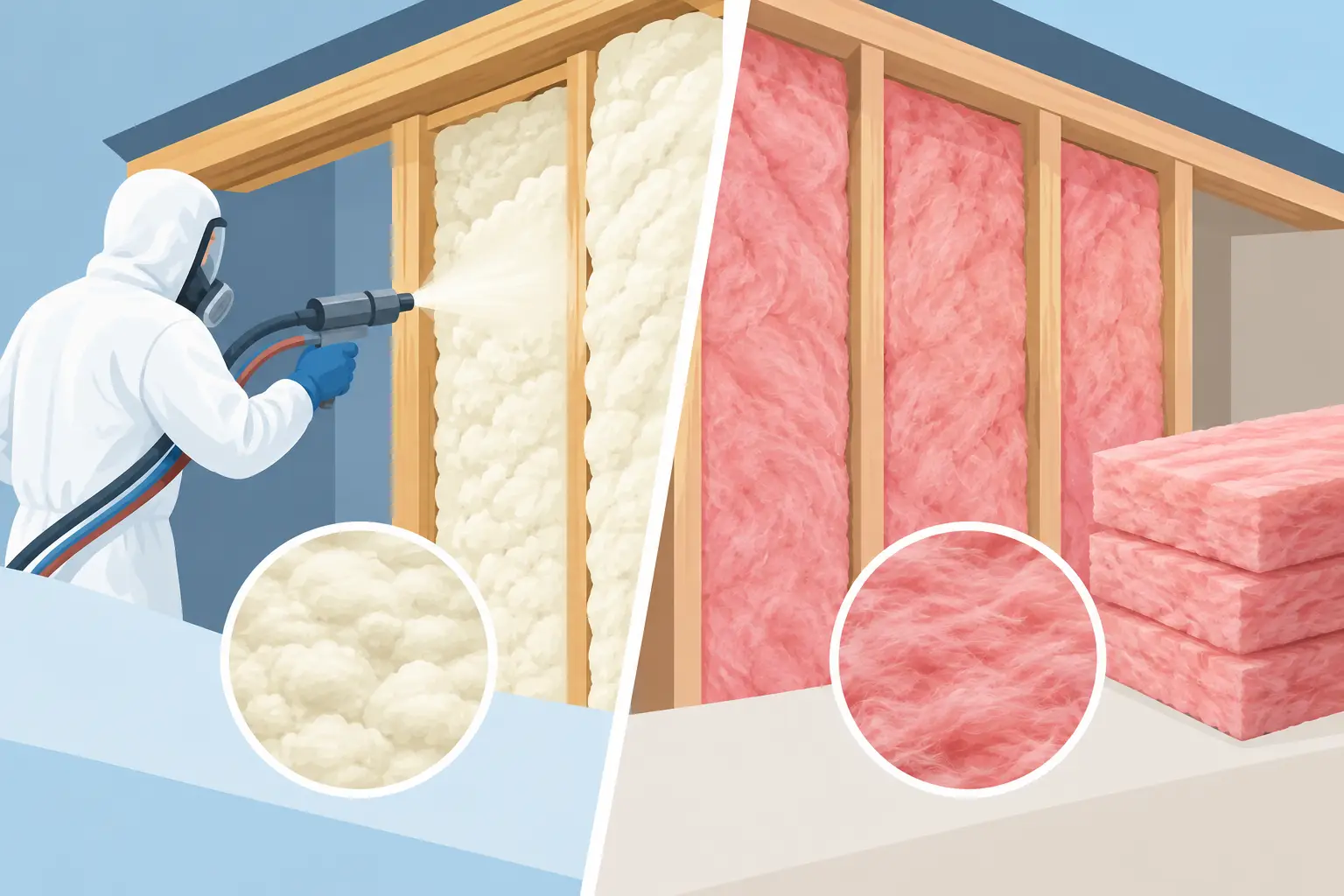
A New Orleans attic can reach punishing temperatures long before the afternoon storm rolls in. If that heat, humid air, and moisture are moving freely through your ceiling or roofline, your air conditioner has to work harder to keep up. The choice between spray foam versus fiberglass insulation affects more than an R-value on paper. It can affect cooling costs, indoor humidity, HVAC equipment run time, and the long-term condition of the building.
For Southeast Louisiana homes and commercial properties, there is no one insulation material that wins every project. The best choice depends on where the insulation will go, whether the building has air leaks or moisture issues, the condition of the roof, the available budget, and how the HVAC system is designed.
Spray Foam Versus Fiberglass Insulation in Gulf Coast Buildings
Fiberglass and spray foam both slow heat transfer, but they work very differently. Fiberglass is a fibrous insulation material installed in batts or blown loose-fill. It is widely used because it is familiar, readily available, and usually has a lower upfront cost. It performs best when it is installed evenly, kept dry, and paired with proper air sealing.
Spray foam is applied as a liquid that expands and adheres to the surface. It can insulate while also reducing air movement through gaps, cracks, and penetrations. That air-sealing ability is often the deciding factor in hot, humid climates, where outside air can carry significant moisture into the building.
The key distinction is simple: fiberglass primarily resists heat flow, while spray foam can resist heat flow and limit air leakage in the same application. Air leakage is not a minor detail. In a Gulf Coast property, it can bring heat and humidity into attics, wall cavities, and conditioned spaces, increasing comfort problems and moisture risk.
Where Fiberglass Makes Sense
Fiberglass remains a practical insulation option for many projects. In a conventional vented attic with a well-sealed ceiling plane, blown fiberglass can provide dependable thermal performance at a manageable cost. It is also useful in walls, floors, and repair areas where a full spray foam installation is not necessary.
Its affordability can leave room in the budget for other high-value work, such as sealing attic penetrations, repairing duct leaks, improving ventilation, or addressing an aging HVAC system. Those details matter because even a thick layer of fiberglass can underperform when air bypasses it through unsealed openings around recessed lights, plumbing stacks, attic hatches, and duct connections.
Fiberglass needs to stay dry and properly installed. Compressed batts, gaps around framing, wind washing in poorly detailed attic areas, and water intrusion all reduce performance. It also does not stop air movement on its own. For a property owner who chooses fiberglass, air sealing should be part of the insulation plan, not an afterthought.
Fiberglass can be the right fit when the attic remains vented, the existing roofline is sound, the ceiling plane can be sealed effectively, and the project calls for a cost-conscious upgrade. It is not an inferior choice by default. It simply requires the surrounding assembly to be detailed correctly.
What Spray Foam Changes
Spray foam is often installed at the roof deck in an unvented attic or directly against exterior walls and other building surfaces. When applied correctly, it fills irregular spaces that are difficult to seal with conventional materials. This can reduce the amount of hot, humid attic air that reaches ducts and equipment.
That matters in many local homes because air handlers and ductwork are often located in the attic. A vented attic can become extremely hot, forcing cooled air through ducts surrounded by intense heat. Moving the thermal and air boundary to the roofline with spray foam can create a more moderate attic environment, which may improve duct performance and reduce strain on the cooling system.
There are two common types of spray foam. Open-cell foam is lighter and expands significantly, making it useful for filling cavities and roof decks in appropriate assemblies. Closed-cell foam is denser, provides more R-value per inch, and offers stronger resistance to moisture vapor. The right material depends on the location, roof assembly, required thickness, and moisture conditions.
Spray foam has trade-offs. It generally costs more than fiberglass, and it must be installed by trained professionals using the right preparation, thickness, and jobsite safety procedures. The building also needs to be evaluated as a system. Tightening the envelope may change ventilation needs, combustion-air requirements for certain equipment, and HVAC sizing assumptions.
Spray foam is not a repair for an active roof leak, hidden rot, or a drainage problem. Those conditions need to be corrected first. Encapsulating a wet or damaged assembly can make a costly problem harder to detect and resolve.
Comparing Cost, Performance, and Moisture Control
The upfront price difference is usually the first concern. Fiberglass typically costs less to install, especially across large open attic areas. Spray foam costs more because of the material, specialized equipment, site preparation, and installation expertise. But the initial price alone does not show the full value of either option.
A spray foam project may deliver a greater improvement where uncontrolled air leakage is a major source of energy loss and humidity intrusion. It can also be especially valuable when ducts are located in the attic or when the building has complex framing and difficult-to-reach gaps. In those situations, the air-sealing benefit may be as important as the insulation value.
Fiberglass may offer a strong return when the existing attic can be air sealed, ventilation is functioning as intended, and the main need is additional thermal resistance. For some properties, the best answer is not one material everywhere. A hybrid approach can use spray foam in targeted leakage areas and fiberglass where deep, economical coverage makes sense.
Moisture control deserves special attention in Southeast Louisiana. Closed-cell foam can limit vapor movement in certain assemblies, while open-cell foam may allow more drying potential depending on the design. Fiberglass does not manage bulk water or stop humid air by itself. No insulation material replaces a sound roof, proper flashing, controlled drainage, adequate HVAC operation, or prompt repair of plumbing leaks.
How Attic Design Affects the Decision
The insulation location changes the entire strategy. In a traditional vented attic, insulation is placed on the attic floor, above the conditioned living space. The attic stays outside the conditioned envelope, and ventilation details must work with the roof design.
In an unvented attic, spray foam is commonly applied at the roofline, bringing the attic closer to the conditioned envelope. This can be beneficial when HVAC equipment and ducts are located there, but it is not a simple material swap. The roof assembly, mechanical systems, combustion appliances, and ventilation approach should all be reviewed before work begins.
Older New Orleans-area properties can add another layer of complexity. Historic construction, additions built at different times, raised foundations, irregular framing, and previous repairs may create hidden pathways for air and moisture. A quick look at insulation depth does not always reveal the real source of discomfort or high utility bills.
Choose Based on the Building, Not the Sales Pitch
The right recommendation starts with an assessment of the property. Look for attic temperature, duct condition, visible moisture staining, roof leaks, insulation gaps, blocked ventilation, mold concerns, and major air-leak locations. Review how the HVAC system is performing as well. An oversized, undersized, poorly maintained, or leaky system can create comfort problems that insulation alone will not solve.
For a straightforward attic upgrade on a limited budget, air sealing followed by properly installed fiberglass may be the most sensible path. For a home with attic ductwork, persistent heat gain, humidity concerns, and substantial leakage at the roofline, spray foam may justify its higher installation cost. Commercial buildings need the same whole-building thinking, with added attention to occupancy, operating schedules, refrigeration loads, and roof configuration.
Air Tight Construction approaches insulation as part of building performance, not as an isolated product decision. The goal is to reduce unwanted heat and moisture movement while supporting the HVAC system and protecting the structure.
A good insulation project should leave you with more than a thicker attic. It should give your property a clearer path to steadier temperatures, better humidity control, and fewer surprises when the Louisiana heat settles in.